
Southwest Airlines Grounds Open Seating in Strategic Pivot Toward Higher-Value Fares
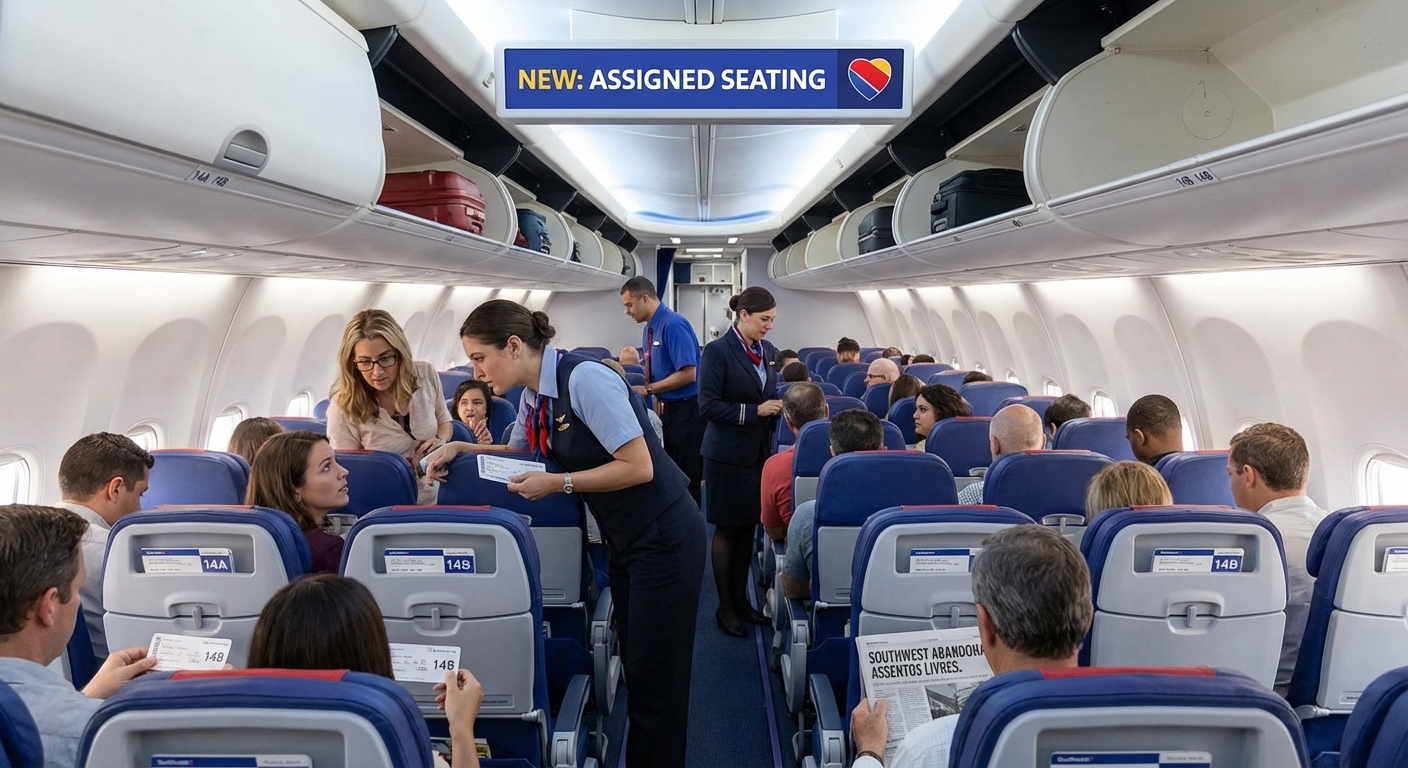
Imagem meramente ilustrativa, criada por I.A.
Southwest Airlines, long an iconoclast in the commercial aviation sector, initiated a fundamental change to its passenger experience on Tuesday, officially scrapping its famous open-seating policy in favor of assigned seats. While the company frames the decision as a response to customer preference for predictability, financial analysts view it as a critical and long-anticipated maneuver to bolster revenue and align its product more closely with the expectations of high-yield business passengers.
For nearly five decades, the Dallas-based carrier built a fiercely loyal customer base around a simple, transparent value proposition: no assigned seats, no baggage fees, and no change fees. This unbundled, egalitarian approach was not just a marketing quirk; it was central to an operational model optimized for rapid aircraft turnarounds and cost efficiency. The 'cattle call' boarding process, while derided by some, was an integral part of this lean economic engine. The transition to assigned seating, therefore, represents more than a mere procedural tweak—it signals a recalibration of the airline's core economic strategy.
The Ancillary Revenue Imperative
At the heart of this strategic shift lies the airline industry's relentless pursuit of ancillary revenue—income generated from sources other than ticket sales. By implementing assigned seating, Southwest unlocks a powerful toolkit for revenue maximization that has become standard at legacy carriers.
- Seat Selection Fees: The airline can now monetize preferred locations, such as aisle seats, window seats, and those in the front of the cabin, catering to passengers willing to pay a premium for comfort or convenience.
- Premium Seating Products: This opens the door for creating distinct fare classes or add-ons, like extra-legroom options, which command higher prices and significantly improve profit margins per flight.
- Competitive Parity: The move eliminates a key point of friction for corporate travel managers, whose booking systems and traveler policies are built around the predictability of assigned seats. This positions Southwest to more effectively compete with giants like Delta, United, and American for lucrative corporate accounts.
Analysts project this change could add hundreds of millions of dollars to Southwest's annual revenue, providing a crucial financial buffer in a notoriously cyclical industry with volatile fuel costs and thin margins. It is a calculated trade-off, sacrificing a point of brand differentiation for a more robust and diversified income model.
A Calculated Risk to Brand Equity
The decision is not without significant risk. Southwest's brand value is deeply intertwined with its reputation for being different, customer-friendly, and refreshingly simple. The open-seating policy was a tangible symbol of this ethos. Alienating a segment of its loyal leisure-traveler base, who valued the unique experience and saw it as part of the airline's charm, could have long-term consequences for its brand equity—a critical, if intangible, asset.
Investors will be closely watching key performance indicators in the coming quarters. While the immediate focus will be on the uptick in ancillary revenue, Wall Street will also scrutinize metrics like customer satisfaction scores, load factors, and, most importantly, Revenue per Available Seat Mile (RASM). The ultimate success of this historic pivot will depend on whether the new revenue from seat selection and premium travelers outweighs any potential erosion of its core customer base and the unique market position it meticulously built over half a century.